For decades, the field of psychotherapy has been characterized by a proliferation of diverse, and often seemingly disparate, theoretical models and clinical techniques.
Practitioners from different schools often perceive themselves as operating in separate worlds, adhering to methodologies within distinct theoretical frameworks. This has led to a persistent challenge, namely, the lack of a shared, empirical framework for understanding and evaluating the fundamental mechanisms of therapeutic action.
A unified theory of action would enable practitioners to:
- Understand how different techniques function to modify memory.
- Influence therapeutic outcomes.
- Provide a richer array of options for clients.
In his 2024 publication, Bruce Ecker addresses this challenge by proposing a framework for psychotherapy unification based on memory modification processes.
His thesis is that most, if not all, therapeutic action can be understood as a “reconfiguration of knowledge held in memory,” which includes both episodic (personal experiences) and semantic (perceived patterns) memory. He identifies two primary, qualitatively different modes of memory modification that account for the full spectrum of therapeutic outcomes.
Mode 1: Competitive Change
This first mode of therapeutic change involves inducing new learning designed to create a memory that interferes with and diminishes the expression of a target (existing) memory.
- Best Exemplified By: Extinction training, as seen in cognitive behavioral therapies and exposure therapies.
- The Mechanism: The process does not eliminate the original memory; instead, it creates a separate, second learning in the prefrontal cortex that temporarily suppresses the original engram in the amygdala.
- The Outcome: The target learning remains intact, making the resulting symptom reduction “partial, unstable, and susceptible to relapse,” and requiring “the ongoing effort of remembering and carrying out the competitive practice.”
Mode 2: Core Change
This second mode, as described by Ecker (2024), operates through the mechanism of Memory Reconsolidation (MR).
This is the brain’s process for achieving “true unlearning” and the “enduring cessation of a symptom and its underlying theme of emotional distress“. This mechanism fundamentally revises or “rewrites” the neural encoding of a memory, making relapse impossible.
The discovery of MR overturned the long-held belief that once a long-term memory was consolidated, it was indelible. Ecker delineates three essential experiential steps for this process to occur:
- Reactivation of the Target Memory.
- A concurrent Prediction Error Experience that mismatches the memory’s expectations.
- An Experiential Updating process of new learning during the reconsolidation window.
This process results in permanent, effortless change, which Ecker posits is the basis of transformational outcomes in psychotherapy.
The Distinction between these two modes of change is a fundamental philosophical difference: managing symptoms through competing learnings versus resolving symptoms at their origin through unlearning.
Where CMI Fits In
The CMI therapeutic process is a phased approach that focuses on integrating the critical memory as a clinical outcome by directly and intentionally facilitating the conditions required for memory reconsolidation. This methodical progression transforms Ecker’s theoretical model into a practical, repeatable, and clinically useful methodology. The following table provides a high-level overview of this synthesis.
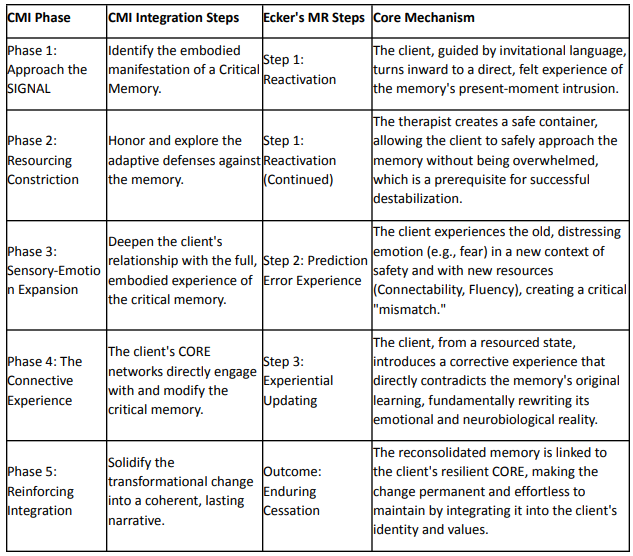
From Theory to Clinical Reality
While the synthesis above illustrates the theoretical alignment between CMI and Ecker’s Unified Model, the true value lies in the clinical application. For the therapist, shifting from Competitive Change (symptom management) to Core Change (symptom resolution) requires not just new knowledge, but a structured, repeatable framework.
It is one thing to understand the neuroscience of a Prediction Error; it is another to reliably facilitate one in the therapy room.
CMI translates these abstract concepts into a clear, phased protocol designed to resolve complex trauma without the risk of relapse. We invite you to explore how this methodology is structured and how it differs from standard exposure approaches.
Ecker, B. (2024). A proposal for the unification of psychotherapeutic action understood as memory modification processes. Journal of Psychotherapy Integration, 34(3), 291.
If you are curious how CMI’s phased protocol would fit into your specific practice, or how it compares to the modalities you are currently using, we invite you to speak with us directly!